a living portfolio
Gabriel
Rovina
— a curious engineer,
fluent in good-humour and python.
I keep crossing disciplines for the fun of understanding things — physics, deep learning, biology, big systems — and I can't help turning the ideas that grip me into things you can see.
see the colours↓a record of the things I can't stop looking at
Colours
Colours is where I keep the things that fascinate me — the moments when engineering, mathematics, nature and life turn out to be having the same conversation.
Mathematics hanging from a tree. The convection in a coffee cup that also runs the atmosphere, the Earth's core, the Sun. A neural network that, squinted at, seems to have learned Plato's Forms.
I build each one because I want to see it for myself — and the seeing is the whole joy. Each one is me pointing at something and saying: look at this.
Personal
Playing with Mandelbrot's exponent
Mandelbrot called himself a "fractalist", and his set is the complex numbers that stay bounded under z² + c, again and again. Playing with it, I noticed something when the exponent over z changes: the number of side-bulbs follows the exponent, in a mesmerising kaleidoscopic effect. Here it breathes from 2 to 8 and back.
Personal
Mathematics hanging from a tree
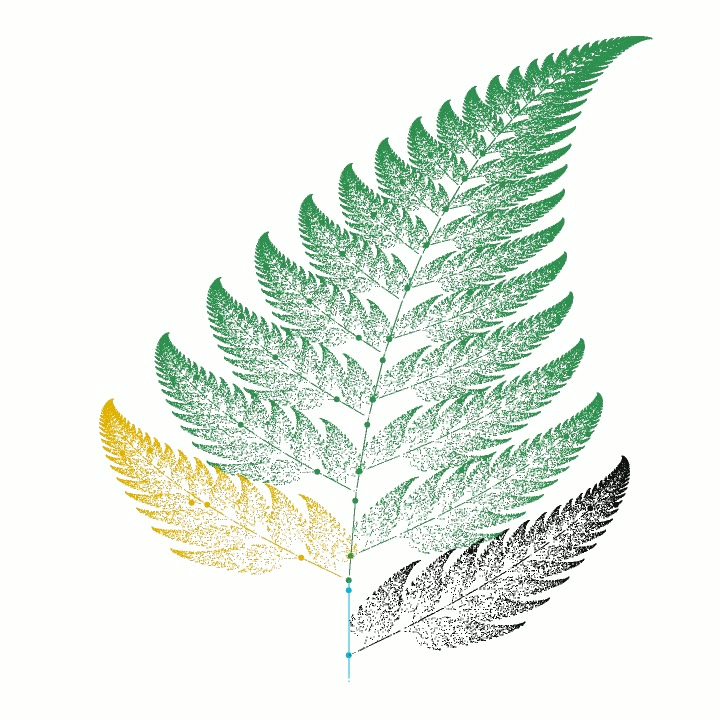
Fractals show up everywhere in nature, and it's surprising to watch natural patterns emerge from simple rules. Barnsley's fern is generated by repeatedly applying one of four affine transformations to a point. I colour-marked each point by the transformation that made it — and four distinct regions appear: the stalk, the two first leaflets, and all the rest.
Personal
Kneading the dough with the Rössler attractor
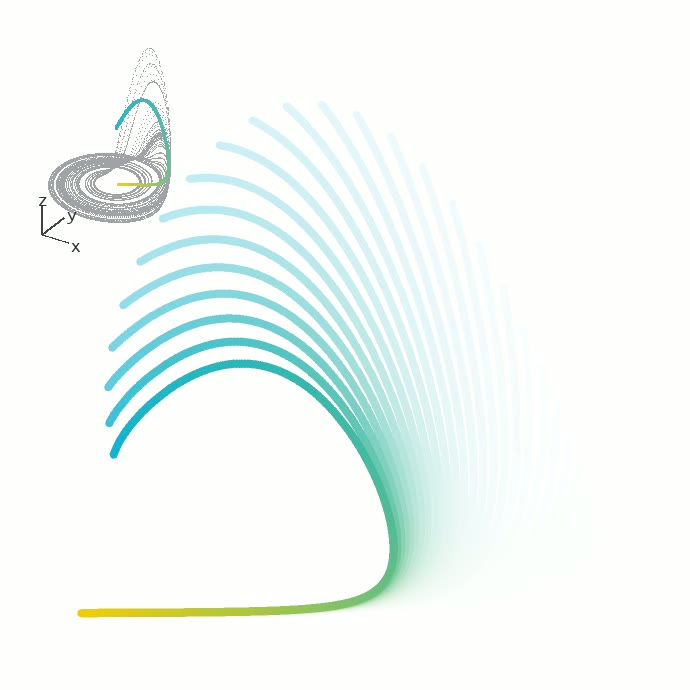
I love when systems full of differential equations explain something you can touch. Inject a straight line of dye into the Rössler attractor — beads holding hands, reaching out from the centre — and let the spinning disc carry it round: the line stretches, the far end folds back over itself, and the clean stripe kneads itself into chaos. Strangely like kneading bread dough.
École Polytechnique2014
Every vowel is a tube
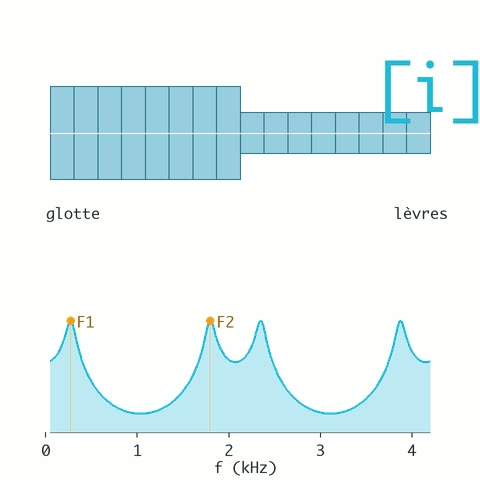
A vowel is just a shape. The vocal tract is a pipe from the glottis to the lips, and its cross-section picks out a handful of resonant frequencies — the formants — that the ear reads as “a” or “i”. For a project at École Polytechnique I modelled the tract as a chain of little tubes and computed its transfer function; here the shape morphs a→e→i→a while the formants F1/F2 slide beneath it. Press play to hear the same equations speak.
Grovina · Galleon
A personal health knowledge graph
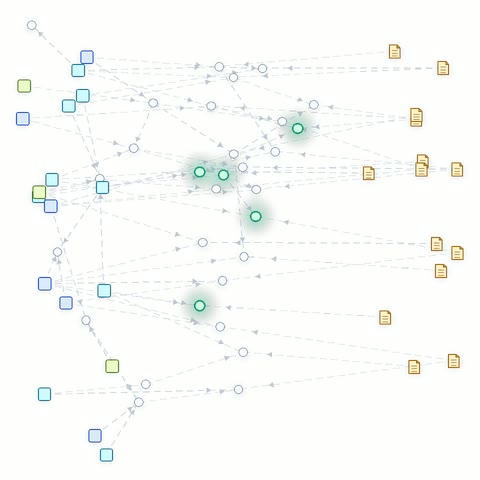
You already run a protocol on yourself — the rules and beliefs about your own body, assembled over years. Galleon grows it into a living graph where your words and data meet the medical literature, every claim traceable to what it rests on, until one small, well-earned change surfaces. The graph forming is the visualisation.
Filmograma
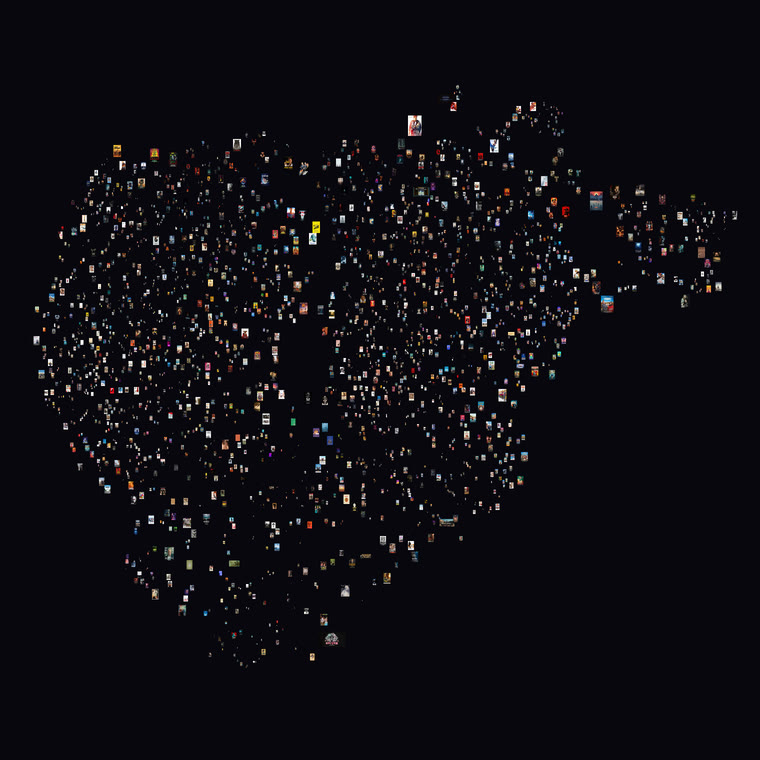
A map of all Brazilian cinema
Filmograma ingests the whole Brazilian audiovisual universe — this visualization is one interest snapshot of it: every film that ever sold a ticket, placed by what its story is about, and sized by tickets sold. We currently use 50+ pipelines to ingest and process data daily, including production and distribution data, cast, direction, prizes and awards, social media signals... covering around 140k screened audiovisual works. Besides cool visualizations worth an Oscar themselves, we also produce analyses that help producers and distributors optimise their outcomes.
École Polytechnique
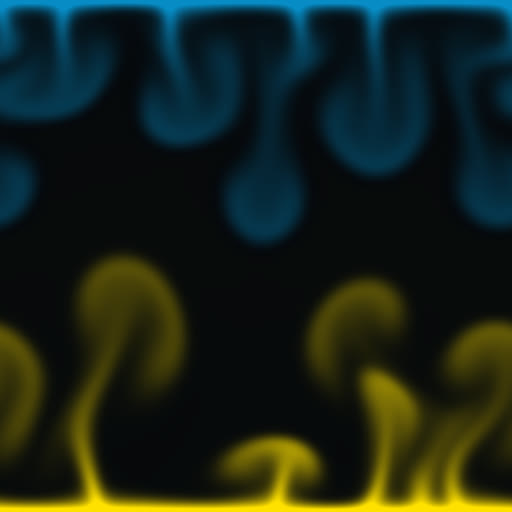
Convection between hot and cold
A heated pan — the same convection as in a room, the atmosphere, the Earth's core, the Sun. The intriguing thing about turbulence is that it appears on its own: no blender, no stirring the equations with a spoon. Even a naively symmetric setup leads to unpredictable fluid choreographies. From an Applied Maths project at Polytechnique.
École Polytechnique
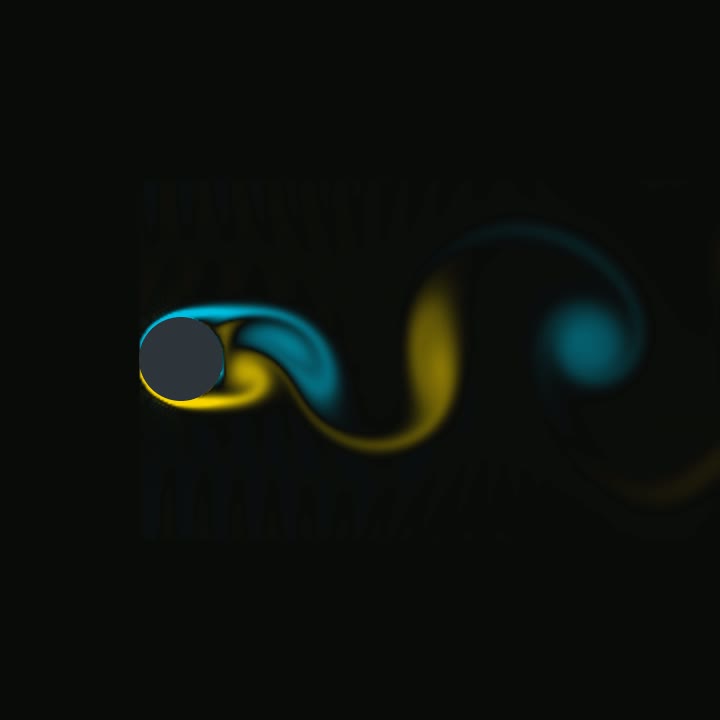
Von-Kármán vortex street
Even something as simple as a cylinder in the wind shows how powerful a visualisation can be. Vary the wind speed and the vortices from one side start to dominate — steering the flow and giving the other side room to take over, in a seesaw of vortices. From a Fluid Mechanics project at Polytechnique.
Politecnico di Milano2015
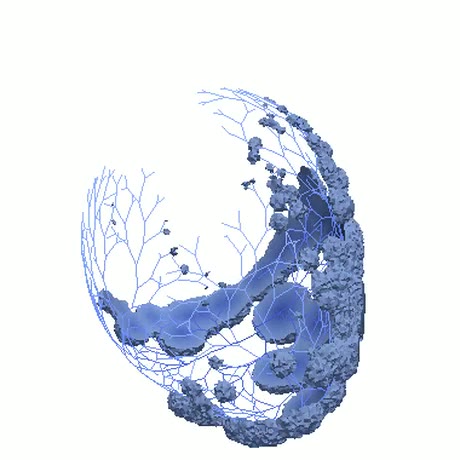
Electrical activation of the left ventricle
One of my most fulfilling internships: optimising pacemakers for patients with defective electrical activation. A 3D heart model with real data reproduces the actual activation of the fibres and muscle — this animation — and its response to pacemakers. We could even repair the problematic regions in simulation to get a 'healthy' heart, which became the optimisation target.
Personal
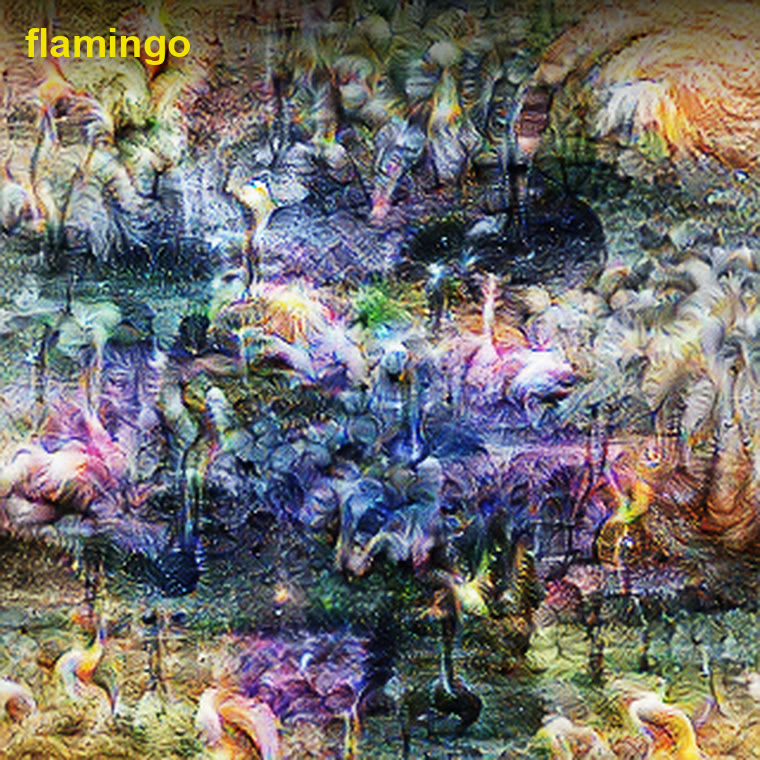
Plato's Theory of Forms in neural nets
Training a net adjusts its weights to minimise output error. What if we froze the weights and adjusted the input instead — maximising a class probability until the essence of the concept condenses? It sounds like trying to find Plato's Form of it. Starting from a blank image, that is what emerges: real ostrich-ness, flamingo-ness, chameleon-ness, panda-ness, out of formless grey.
Walnut Algorithms2016
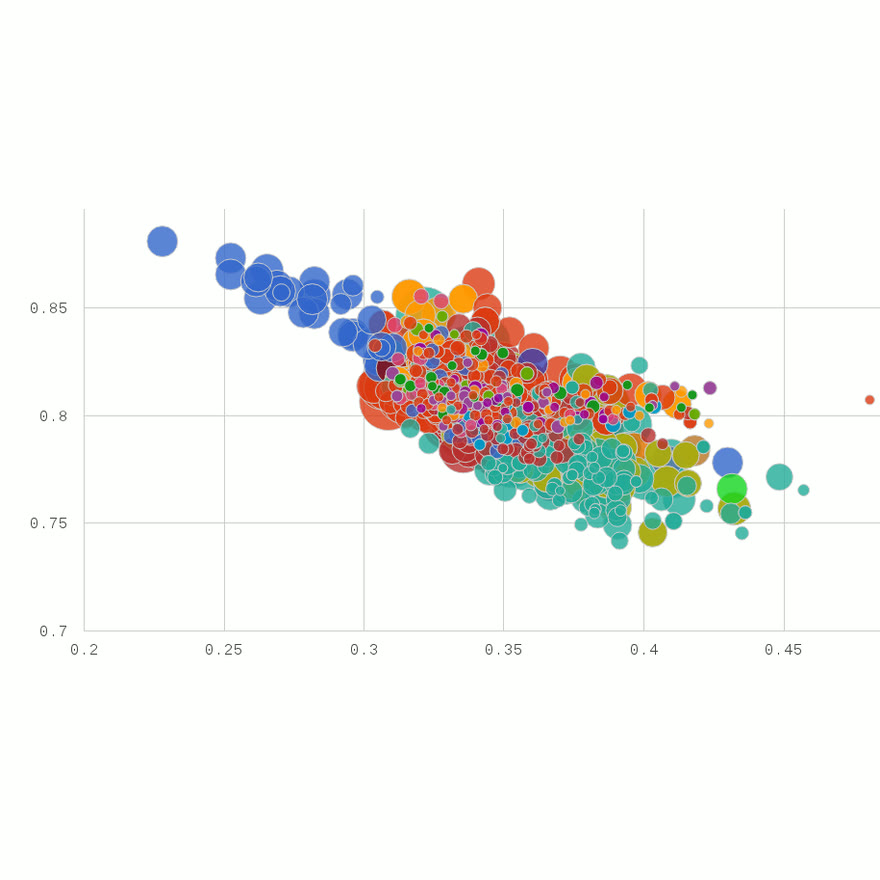
Precision-recall clustering of neural models
During an internship on deep learning for trading I trained hundreds of models, and I'm proud of this one plot that summarises them all. Each circle averages three benchmark datasets: position is precision and recall, size is the parameter count, colour is a cluster of similar hyper-parameters. It showed how the families compared — and which regions had been explored, and which hadn't.
École Polytechnique
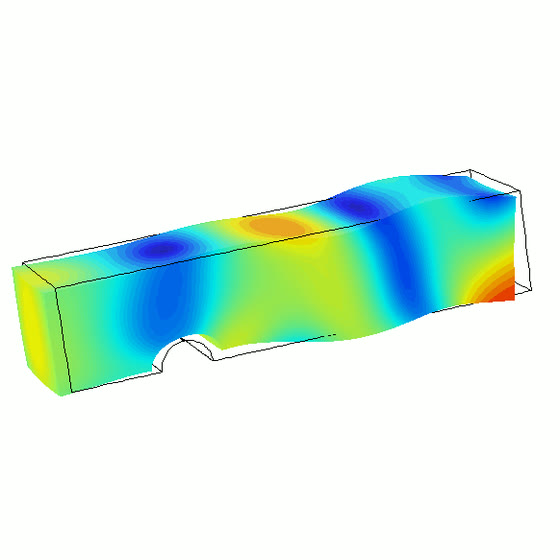
Vibration modes in piezoelectric bars
An engineering project at Polytechnique: designing a bionic precision grip from piezoelectric bars. Find the right geometry and the right mode of vibration and you get a pinching effect — which I modelled in 3D to understand the phenomenon and its side effects.
University of São Paulo2011
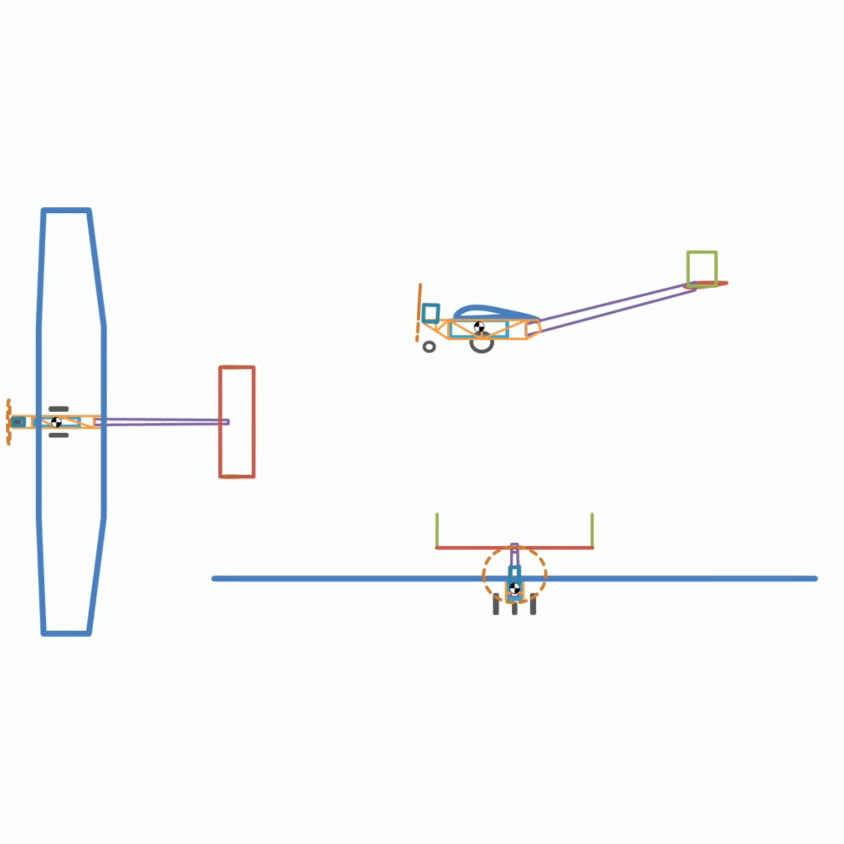
Multidisciplinary optimisation for a cargo plane
On the university AeroDesign team I carried the multidisciplinary optimisation — merging every project area into a single algorithm to find the design directions that mattered. This is the process that defined our 2011 plane: it won the Brazilian national competition and finished 2nd in the world.
myBlee / LGM Learning
Path optimisation in a learning app
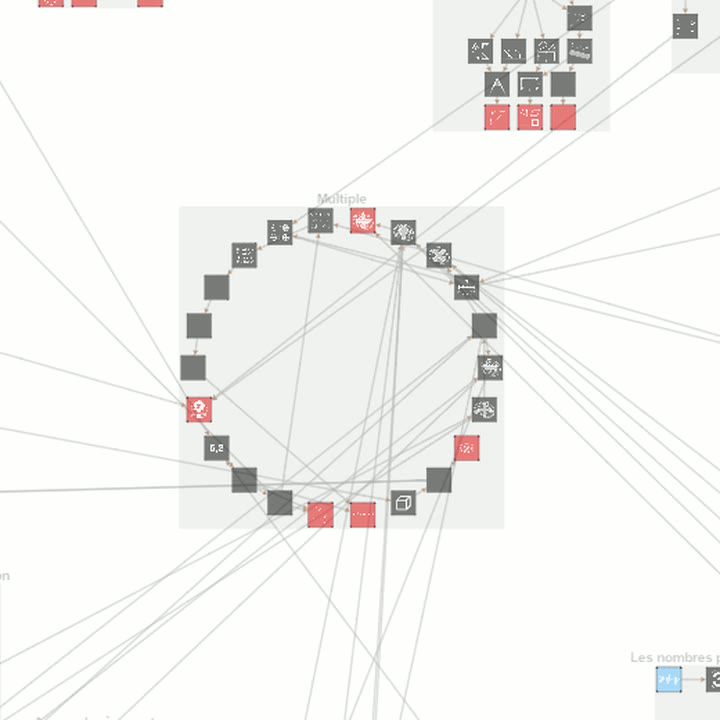
At LGM Learning I built a recommender to guide kids through maths. This tool — central to my exchanges with the teachers — shows every module clustered by similarity, with the optimal learning trajectories the algorithm proposed. Curiously, it ended up fitting a Travelling Salesman Problem, which I solved with an Ant Colony Optimisation algorithm.
Personal
Social circles, borrowers and lenders
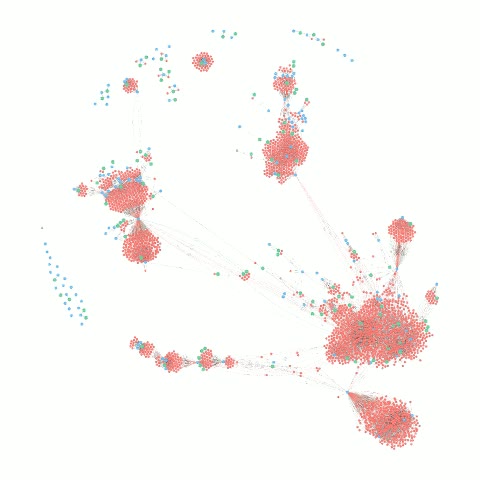
After some hard times splitting trip bills, my brother and I built a web app for friends to track shared expenses. On its first anniversary I drew the real debt network from the users who consented — every person a node, every IOU an edge. Social circles fall out as dense clusters, with lenders and borrowers bridging them: holistic insights over a full year that often weren't obvious even to the users themselves.
Grovina · core lab
A Mandelbrot that spirals into itself
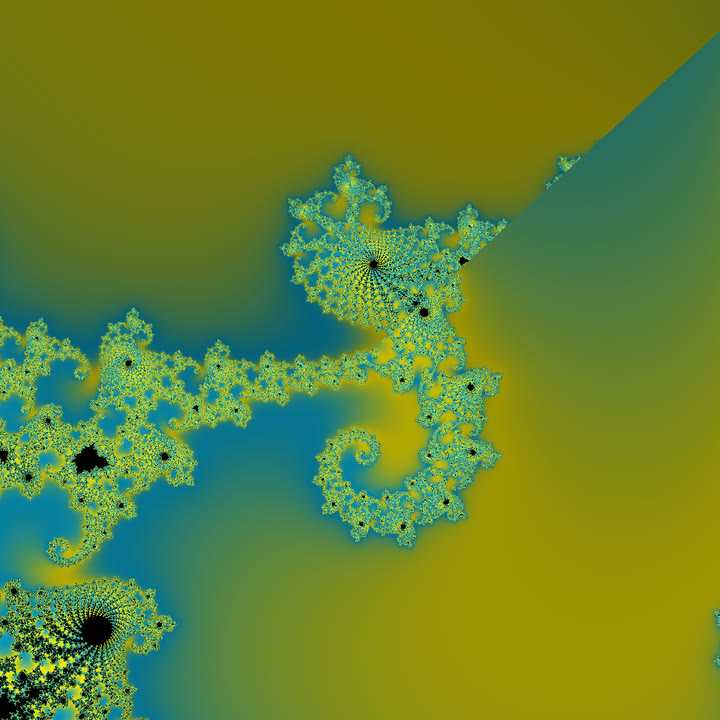
The Mandelbrot set under a conformal log transformation — the Droste effect. Circles become logarithmic spirals and the boundary coils endlessly into its own detail. One full turn returns exactly to where it began.
Grovina · lab
Hunting a glider in hex life
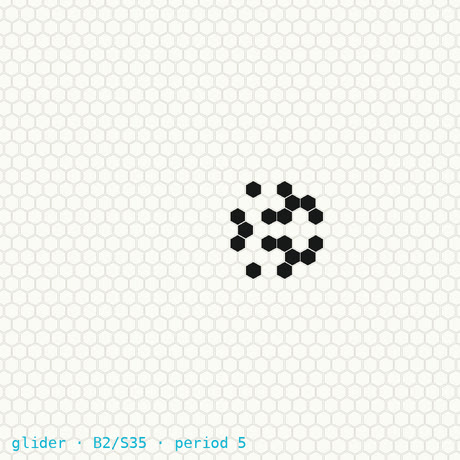
Hex Game of Life — a cell born with two living neighbours, surviving on three or five. Almost nothing here moves: brute-force every small seed and not one glides; random soups only churn and die. So I set evolution loose inside it — a population of patterns, bred, mutated and selected across generations, rewarded for travelling farthest. There is something fitting about using evolution to search for life that moves, inside the Game of Life itself. After thousands of dead ends, one pattern refuses to die: a period-5 glider that walks the board, one hex every five generations. Live at the lab.
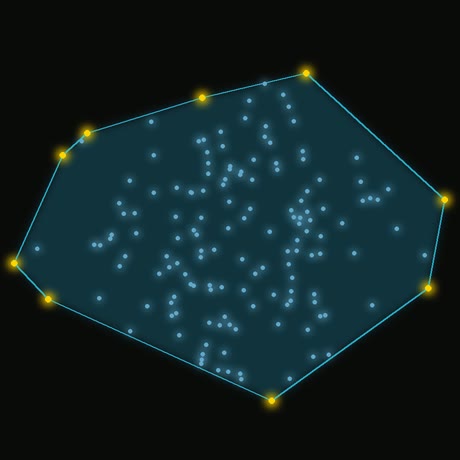
Anchorage Protocol
Science growing toward its convex hull
A field's papers are scattered points of knowledge — but a finding from one, a method from another, and a counter-example from a third can support a claim no single paper makes. Agents harvest that in-between knowledge in their idle time, each small peer-reviewed assignment a node anchored to its sources. The graph fills in toward the convex hull of the literature: every conclusion already implied by the papers, that nobody ever had the time to draw out. Live at anchorage.science.
about
An engineer who keeps walking into new fields.
Started in physics (olympiad medals) and aeronautics, detoured through deep learning before it was fashionable, simulated hearts to optimise pacemakers, co-founded a computer-vision company, built large-scale cloud infrastructure, then spent about six years at Google working on Assistant and Gemini.
Now independent: advising founders on AI product & data strategy, teaching deep learning, and building a personal platform of some twenty shipped apps — many of them experiments in making the invisible visible.
- Based in
- Zurich
- Languages
- PT · EN · FR · ES · IT · DE
- Patents
- 2 (LLM output editing)
- Currently
- AI product & data strategy · teaching DL